
Buying guide · Juicers

The best cold-press juicers of 2026

Five slow juicers, four things I look for, and a guide to what deserves your counter space.

Mustafa, author of Juicing with Mustafa

Written by Mustafa

Written by Mustafa · September 2026

Sponsored post

I’ve worked in the juicing world for a long time, and the same questions keep coming up. What makes good juice? How much work is the machine going to add to your morning? And is the price worth it for what you actually juice?

This guide answers those three for five slow juicers. Same criteria for every machine, no favorites going in.

You can’t outwork a bad diet.

The easiest daily fix I know is one glass of juice you pressed yourself. So here is what matters about the machines themselves: what they cost, what they’re built to do well, and where each one falls short.

Framework

How I evaluate a juicer

Those are the four things I look at when I compare juicers — juice quality, ease of use, versatility and noise — with price, warranty and kitchen fit as the buying tradeoffs on top. The specs tell you what a machine offers; the framework helps you decide whether that matters in your kitchen. The ratings here are my editorial judgment under those four criteria, not a lab score.

01

Juice quality

Color, foam, texture and how much juice stays in the pulp. Those are the things I'd compare. The pressing system and strainer design are useful starting points; RPM alone doesn't tell you how good the juice will be.

02

Ease of use

Assembly, feeding, and cleanup above all of it. A machine that takes ten minutes to clean is a machine you stop using inside a month. If cleanup becomes a chore, the machine is less likely to stay in your routine.

03

Versatility

Leafy greens, hard roots like ginger and beet, soft citrus, nuts for milk. A juicer that only wants apples and carrots is not really a juicer, okay?

04

Noise

If you juice at 5 a.m. with people still asleep upstairs, noise counts for something. Slow AC motors are the quiet ones; check the RPM and the motor type before you assume.

Primer

What cold-press means, if you're new here

A centrifugal juicer shreds the produce with a blade spinning very fast. That makes heat and it pulls in air, and both of those work against the nutrients you're juicing for in the first place. A slow juicer presses instead. You'll see them called masticating, or cold-press, it's the same thing. An auger squeezes the produce against a strainer at low RPM, the way you'd squeeze an orange in your hand.

Charlie Wettlaufer at Goodnature, whose work I admire, put this through a lab. Straight out of the machine, the cold-pressed juice had 15% more vitamin A, 16.2% more folate and 13.1% more vitamin C than the centrifugal juice.

257%

more vitamin A than centrifugal juice after 72 hours in the fridge

350%

more vitamin C over the same 72 hours

The practical difference people notice is simpler than the lab numbers. Cold-pressed juice doesn’t separate on you, and a batch still tastes right two days later. Every machine in this guide is a slow juicer. The only question is which one.

At a glance

My 2026 picks, in order

  1. Hurom H80$749
    4.9 / 5

    Overall winner, daily and family juicing

  2. Kuvings AUTO10 Plus$769.99
    4.6 / 5

    Biggest batches

  3. Kuvings REVO830$699.99
    4.5 / 5

    Carrot and celery juicers

  4. Tribest Greenstar Elite$599.95
    4.4 / 5

    Leafy greens and wheatgrass

  5. Canoly C16$199.99
    4.2 / 5

    Budget pick

Hurom H80 Slow Juicer
1Winner

Hurom H80 Slow Juicer

4.9 / 5$749

Pros

  • 2-liter self-feeding hopper with a larger inlet, so you keep adding produce while it runs
  • Spiral Blade in the hopper keeps kale and celery moving instead of clogging
  • 50 RPM slow squeeze designed for low-pulp juice and dry pulp
  • Three strainers in the box: fine for juice, coarse for smoothies and thicker juice, ice cream for sorbet
  • Dishwasher-safe components
  • Quiet 150-watt AC motor
  • BPA-free, made in South Korea
  • 15-year warranty on motor and parts

Cons

  • $749
  • About 18 inches tall, so measure under your cabinets
  • Big pits, peaches and plums, have to come out before juicing

The H400 won the last version of this guide, and the H80 is the next machine out of that same family. What it addresses is the step that used to need babysitting, which is feeding.

The two-liter hopper matters if you make juice for more than one person. It feeds the produce for you, and the wider inlet lets you top it up as it runs. That's the kind of convenience I'd put ahead of an extra attachment, because it's the difference between standing at the counter for the whole run and getting on with your morning.

The Spiral Blade is the new part. It sits up in the hopper and is designed to keep fibrous produce moving down into the auger. Kale and celery are the two ingredients most likely to stall a slow juicer. If kale and celery are regular ingredients for you, that is a feature worth looking at.

For juice quality, I look at the strainer options as well as the pressing system. The fine strainer is for everyday juice, the coarse one for a thicker vegetable juice or smoothie base, and the ice cream strainer for softened frozen fruit. That's useful versatility if you'll actually use the extras.

Cleanup is where I'd say it separates from the Kuvings. Hurom lists the components as dishwasher safe, and that single line changes the daily math more than any spec on the box. A juicer you dread washing is a juicer you stop using. Of these five, it's the only one whose cleaning story has no "but" attached.

Price is the argument against it. At $749 it costs about what the Kuvings AUTO10 Plus costs and more than everything else here, so if that number is the problem, skip down to the Canoly.
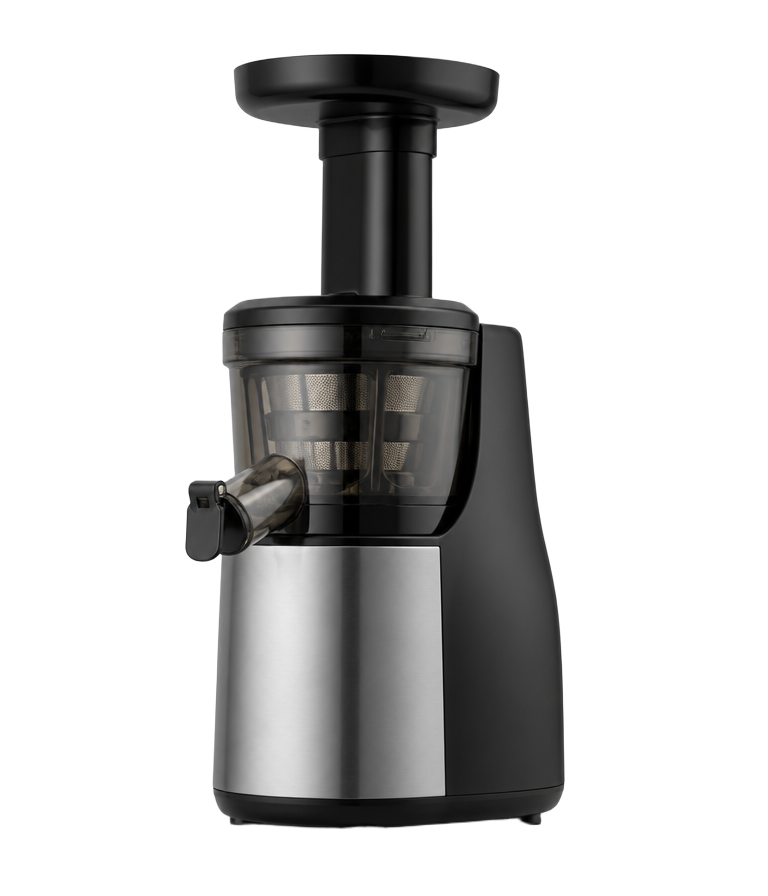
Kuvings AUTO10 Plus Hands-Free Slow Juicer
2Runner-up

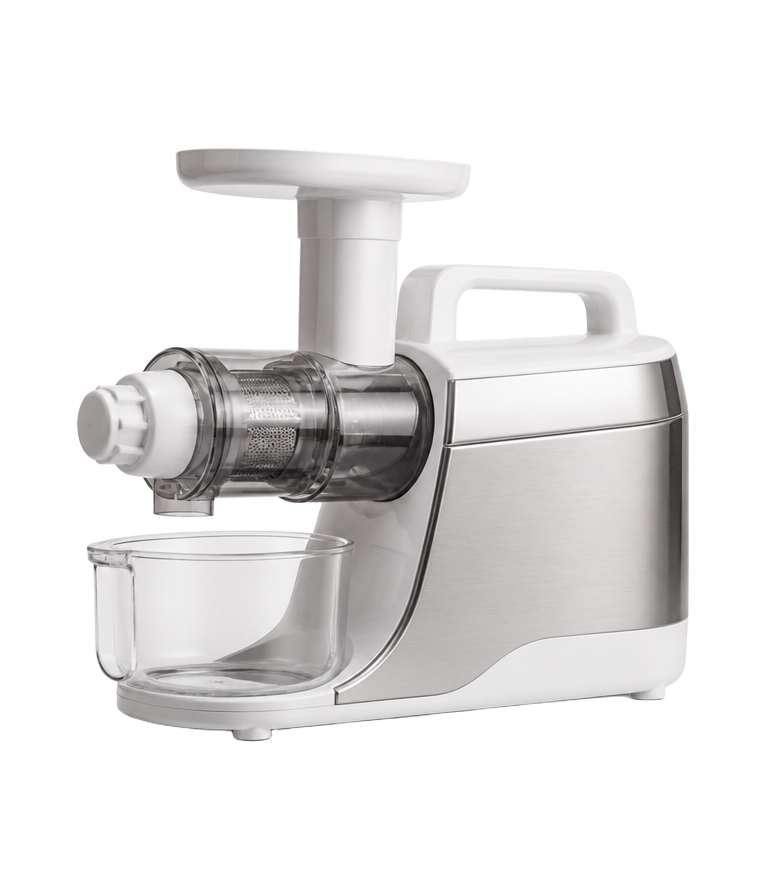
Kuvings AUTO10 Plus Hands-Free Slow Juicer

4.6 / 5$769.99

Pros

  • Largest hopper of the group: 2.7 liters, or 4 liters with the snap-on extension
  • 6.5-inch chute takes whole apples, beets and long carrots without chopping
  • Three strainers (juice, smoothie, sorbet) plus a pulp strainer in the box
  • 240-watt motor, 60 RPM
  • 15-year warranty on parts and motor

Cons

  • None of it is dishwasher safe, and Kuvings ships three cleaning tools for a reason
  • Lots of parts and crevices to hand wash
  • 20 inches tall with the extension, so it may not fit under standard upper cabinets
  • Heavy at 16.5 pounds
  • Slightly more expensive than the H80

Four liters of produce with the extension snapped on, and a 6.5-inch chute that takes whole apples, whole beets and long carrots with nothing peeled and nothing cut. If you juice in volume, this is the only machine here that competes with the H80 on capacity. You load it, you press it, and it feeds itself from there. For a family of five, or for anyone who batches once a week, that's a strong argument.

The four-liter capacity is the reason to consider it. I'd weigh that against the hand washing and the space it needs, because those are the tradeoffs you'll live with every day. A bigger hopper earns its place when you're making enough juice to use it.

It's second because of the cleaning, and cleaning is half of ease of use. Nothing goes in the dishwasher, not one part, and Kuvings puts three cleaning tools in the box for a reason. TechRadar's reviewer called cleaning "the hardest part of using this machine." On something you're supposed to reach for every single morning, that cost compounds. It's also tall, so measure your cabinet clearance before you order.

Kuvings REVO830 Whole Slow Juicer
3Best for celery and carrots

Kuvings REVO830 Whole Slow Juicer

4.5 / 5$699.99

Pros

  • Auto-Cut Chute chops carrots, celery and cucumbers as they feed, which is the hardest job in juicing
  • 3.5-inch flip-gate chute for whole apples and beets
  • Kuvings' most powerful home motor, rated for 45 minutes of continuous use
  • 50 RPM, quiet
  • Smoothie and sorbet strainers included
  • 15-year warranty

Cons

  • Not hands-free, you feed it piece by piece
  • Mesh strainer means more scrubbing than the H80
  • Some owners report cracked strainers with citrus, and Kuvings' own advice is to quarter limes and lemons first
  • Bulky at 16.5 pounds

Long stringy produce, so celery, carrots, cucumber, is what wraps around an auger and stops a machine. The REVO830 has a second chute that feeds those straight into a screw that chops while it presses, and it does that one job very well. If your morning juice is mostly celery, somebody built this for you.

What you give up is walking away. You stand at the REVO830 and feed it piece by piece, and that's what separates a juicer for daily use from one for Sundays. The motor is the strongest one here and it will run 45 minutes straight, which matters if you're going through a case of produce. Most people are still better served by the AUTO10 Plus or the H80.

And do quarter your limes and lemons before they go in. Kuvings says so, and the owners who cracked a strainer learned it the other way.

Tribest Greenstar Elite Twin Gear Juicer
4Best for greens

Tribest Greenstar Elite Twin Gear Juicer

4.4 / 5$599.95

Pros

  • Twin-gear design that outperforms single-auger machines on leafy greens, wheatgrass and sprouts
  • Tom's Guide measured a 75% yield on apple and kale, third best of everything they tested
  • 110 RPM twin gears with magnetic and bioceramic technology, and the reduced-oxidation claim held up in their testing
  • Also makes nut butters and sorbet with the included homogenizing and breadstick blanks; pasta attachments are sold separately
  • Every part except the safety hood and the motor body is dishwasher safe
  • 12-year warranty

Cons

  • No hopper, you push produce through the chute by hand and it takes some pressure
  • Horizontal layout with a big footprint (18.6 W x 6.8 D x 12.4 H inches, 16 pounds)
  • The longest learning curve of the five for assembly and disassembly
  • Small 24-ounce capacity for a machine this size

People who juice wheatgrass seriously talk about twin-gear machines, and the Greenstar Elite is the one they mean. Two gears interlock and crush and grind instead of pressing, and on fibrous greens that design gets more out of the produce than a vertical machine. Tom's Guide measured 75% yield on apple and kale, third best of everything they put through their testing. So if greens are 80% of what you juice, this is a serious machine, and it costs less than the top three.

It's also the least convenient thing here, which is where my second criterion bites. There's no hopper, so you feed it by hand and you push with real pressure, and assembly has the longest learning curve of the five. It lies down instead of standing up, so it wants counter length rather than height. It's a well-regarded machine with a long following, but it is not the one I'd hand to somebody buying their first juicer.

Canoly C16 3-in-1 Cold Press Juicer
5Budget pick

Canoly C16 3-in-1 Cold Press Juicer

4.2 / 5$199.99at canoly.com (regular $299.99)

Pros

  • A self-feeding hopper and a 6-inch chute at a quarter of the price of the H80
  • 90-ounce hopper (2.65 liters), about the same as the H80
  • 250-watt brushless AC motor, quiet
  • 45 to 47 RPM slow squeeze
  • Two strainers in the box, juice and sorbet, and it makes nut milk as well
  • Dishwasher safe
  • Vertical and compact for a self-feeding machine: 9.7 x 6.7 x 17.3 inches, 13.2 pounds

Cons

  • Pulpier juice, and owners on Amazon say to strain it if you want a store-bought texture
  • Celery needs cutting into 1- to 2-inch pieces, per Canoly's own guidance
  • Canoly's written policy covers the whole product for one year and the motor for 15, so whole-product coverage is the shortest of this group
  • New brand with a short track record

At around $200, the Canoly belongs in this comparison because budget changes the decision. I'd look at what it keeps from the more expensive machines, and what you give up.

For the money the spec sheet is remarkable. A real hopper, a wide chute, a quiet motor, two strainers — two years ago that package cost $500 from anybody selling it. Judge it on the four criteria and it holds up on ease of use and versatility; where it gives ground is juice quality, since owners consistently describe pulpier juice and suggest straining it if you want a store-bought texture. If you're new to this and you're not sure yet whether it's going to stick, this is the cheapest way to find out on a machine that won't frustrate you into quitting.

Where it gets thin is the details. Celery has to be cut into one or two inch pieces, and that's Canoly's own instruction. The warranty is worth reading closely too: Canoly's written policy covers the whole product for one year and the motor for fifteen, subject to its terms, so the everyday coverage is shorter than what Hurom and Kuvings put behind their machines. If you can stretch to the H80, part of what you're buying is fifteen years of cover on the motor and parts. If you can't stretch, buy this one and start juicing.

Specs

Side by side

Swipe the table to compare →

SpecHurom H80Kuvings AUTO10 PlusKuvings REVO830Tribest Greenstar EliteCanoly C16
Price$749$769.99$699.99$599.95$199.99
TypeVertical, self-feedingVertical, self-feedingVertical, manual feedHorizontal twin gear, manual feedVertical, self-feeding
Speed50 RPM60 RPM50 RPM110 RPM45–47 RPM
Hopper2 L2.7 L (4 L with extension)NoneNone2.65 L (90 oz)
Chute5.4 in6.5 in3.5 in + Auto-CutNarrow6 in
Motor150 W240 W240 W200 W250 W
StrainersFine, coarse, ice creamJuice, smoothie, sorbet, pulpJuice, smoothie, sorbetFine, coarse + homogenizing blanksJuice, sorbet
Dishwasher safeYesNoNoAll but safety hood and motor bodyYes
Weight13.7 lb16.5 lb16.5 lb16 lb13.2 lb
Height18.0 in17.75–20.25 in19 in12.4 in (horizontal)17.3 in
Warranty15 yr15 yr15 yr12 yr1 yr product / 15 yr motor

Verdict

So which one do you buy?

  • Buy the Hurom H80 if you juice most days, you're feeding more than yourself, and cleanup is the thing that would make you quit. It's my pick of this group and the one I'd put in a kitchen today.

    $749
  • Buy the Kuvings AUTO10 Plus if you batch big and hand washing genuinely doesn't bother you.

    $769.99
  • Buy the REVO830 if celery and carrots are most of what you juice and you're fine feeding it yourself.

    $699.99
  • Buy the Greenstar Elite if you're serious about greens and wheatgrass and this isn't your first juicer.

    $599.95
  • Buy the Canoly C16 if $200 is the budget. It's a real slow juicer, and it will tell you whether you're a juicer.

    $199.99

Last word

The H80 is my pick. What’s yours?

Two years changed this category more than I expected. Hoppers used to be the premium feature and now they come standard, and a $200 machine does what a $500 one did. In the end the gap between my top two came down to one question: do you want to hand wash a juicer every morning before work? I don’t, and that’s why the H80 wins.

That’s my take, not a verdict handed down from a lab. Run these four criteria against your own kitchen, your own budget, and what you put in the machine most days, and you may rank them differently. That’s the point of having a framework.

Top pick

Hurom H80 · $749

See it